In the high-speed world of Grand Prix motorcycle racing, the spotlight often falls on the fire-breathing 1,000cc prototypes of the MotoGP class. However, for those who understand the true essence of racing—strategy, drafting, and razor-thin margins—the Moto3 category is where the real drama resides. Often described as a “rolling chess match at 240 km/h,” Moto3 is the lightweight class of the world championship and serves as the ultimate proving ground for the superstars of tomorrow.
As of the 2026 season, Moto3 continues to be the most unpredictable and action-packed category on the calendar. This article explores the technical intricacies, the unique racing culture, and the historical significance of the division that turns teenagers into legends.
The Technical Blueprint: Precision Over Raw Power
The transition from the old 125cc two-stroke era to the modern Moto3 format in 2012 changed the sport’s landscape. Today, the class is defined by strictly regulated 250cc four-stroke, single-cylinder engines. These machines may look small compared to their premier-class siblings, but they are purpose-built racing prototypes that cannot be purchased in any showroom.
Engine regulations are notoriously tight to ensure a level playing field. Manufacturers like KTM, Honda, and CFMoto (operating under the Pierer Mobility Group umbrella) must adhere to a maximum bore of 81mm and a rev limit usually capped at 13,500 RPM. With roughly 60 horsepower and a minimum weight (bike plus rider) of around 152 kilograms, these bikes possess a power-to-weight ratio that allows for blistering acceleration and corner speeds that occasionally exceed those of the heavier MotoGP bikes.
The 2026 technical regulations continue to emphasize parity. High-tech electronics are simplified compared to MotoGP, meaning there is no traction control or anti-wheelie software to save a rider from a mistake. In Moto3, the right wrist of the rider remains the primary computer.
The Art of the Slipstream: A Tactical Masterclass
If MotoGP is a battle of horsepower and braking stability, Moto3 is a battle of physics and geometry. Because the bikes have limited top-end power, the “slipstream” (or draft) is the most powerful weapon in a rider’s arsenal.
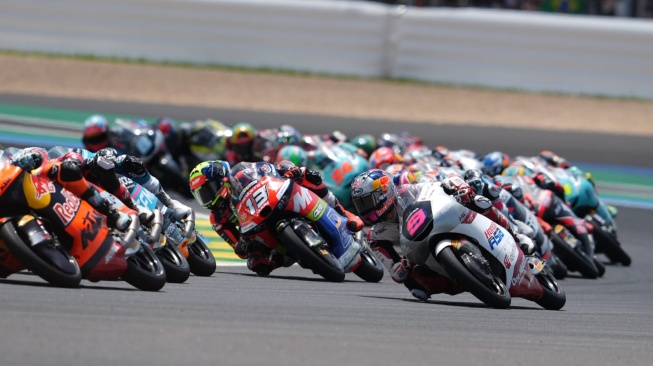
In a typical Moto3 race, it is common to see a lead group of fifteen riders separated by less than two seconds. On long straights, such as those at Mugello or Qatar, the leader is often at a disadvantage. By punching a hole in the air, the lead rider allows the pack behind to gain a speed boost of up to 10 km/h, leading to spectacular four-wide overtakes into the braking zones.
This dynamic creates a unique psychological game. Riders must decide whether to lead the pack and risk being “swallowed” on the final straight or to sit back in fourth or fifth place, perfectly timed for a slingshot victory at the finish line. This tactical depth is why Moto3 finishes are frequently decided by mere thousandths of a second.
The 2026 Season: New Heroes and Familiar Names
The 2026 season has already proven to be a vintage year for the lightweight class. Following the 2025 championship victory by José Antonio Rueda, the grid has seen an influx of hungry talent from the Red Bull Rookies Cup and the FIM JuniorGP.
Names like Brian Uriarte and Rico Salmela have become household staples for fans, representing the next wave of “Aliens.” The competition remains fierce between the leading teams, particularly the Red Bull KTM Ajo squad and the Leopard Racing Honda team. The 2026 calendar has also expanded the global reach of the sport, with the season opener in Brazil providing a high-speed theater that tested the riders’ ability to adapt to new asphalt and humid conditions.
The Proving Ground for MotoGP Legends
Moto3 is not a destination; it is a gateway. Almost every major name on the current MotoGP grid—including Marc Márquez, Maverick Viñales, and the 2024 sensation Pedro Acosta—cut their teeth in this category.
The class teaches riders the “dark arts” of racing: how to defend a line when five bikes are trying to dive-bomb you, how to manage tires that are losing grip in the final three laps, and how to stay mentally focused when the person next to you is rubbing elbows at 200 km/h. For an aspiring champion, surviving and winning in Moto3 is the ultimate badge of competence. It proves that a rider has the tactical intelligence to match their raw speed.
Conclusion
Moto3 GP remains the heart and soul of motorcycle racing because it strips the sport down to its most exciting elements: drafting, late-braking, and fearless bravery. While the “bigger” bikes might have more noise and more gadgets, the lightweight class offers a purity of competition that is increasingly rare in modern motorsport.
As we look toward the remainder of the 2026 season and beyond, Moto3 continues to fulfill its mission. it provides the most entertaining 40 minutes of Sunday television while simultaneously identifying the future icons of the sport. Whether you are a casual viewer or a die-hard technical enthusiast, the Moto3 category offers a spectacle that is, quite literally, second to none. It is where the legends of tomorrow are forged in the heat of the pack today.